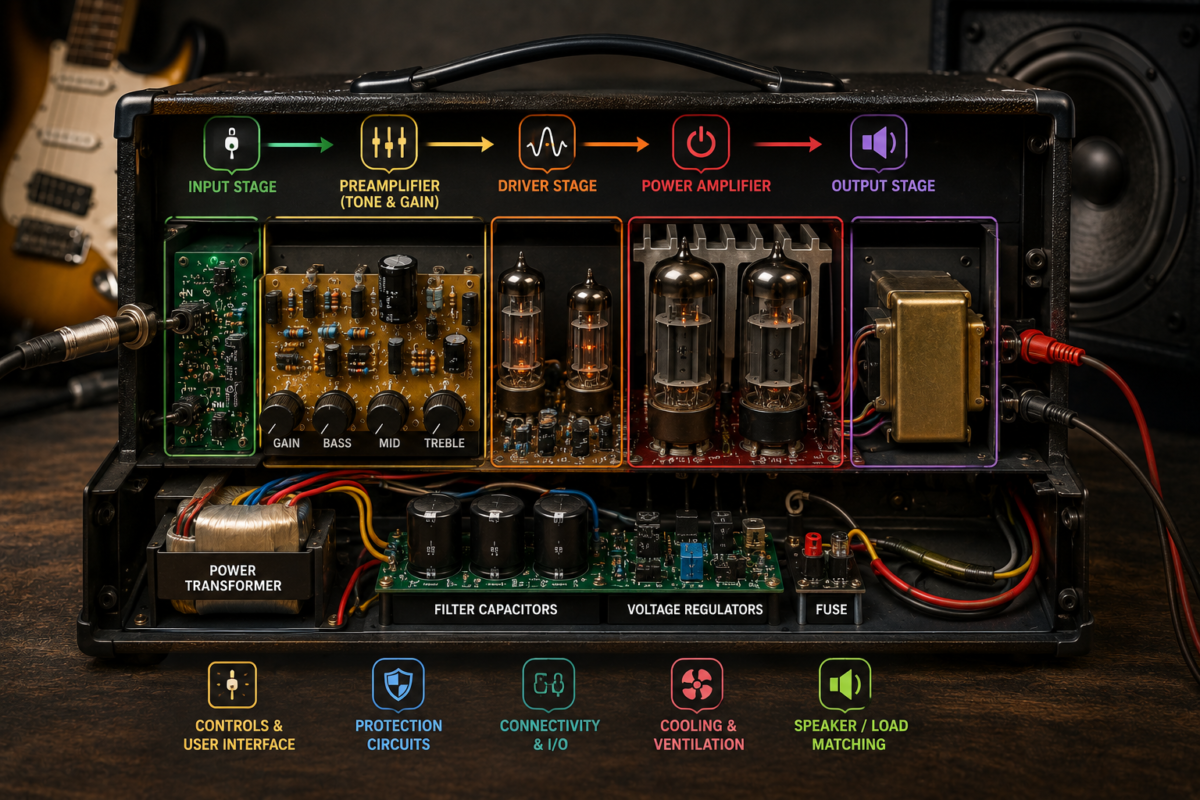
An amplifier is a device that increases the strength of an electrical signal so speakers, instruments, or other devices can produce louder sound. Whether you’re curious about guitar amps, home stereo systems, or audio gear for recording, knowing the main parts of an amplifier helps you understand how sound gets bigger, cleaner, and shaped to your taste. This guide breaks down the essential components, what they do, and how they work together—using simple language and helpful examples.
1. Input Stage: Where the Signal Begins
The input stage is the amplifier’s entry point. It receives the weak incoming signal from a microphone, guitar, phone, or audio player and prepares it for amplification.
- Input jack: The physical connector (1/4″, XLR, RCA, or 3.5mm) where you plug the source.
- Input buffer: Prevents the signal source from being affected by the amplifier’s circuitry; keeps impedance stable.
- Preamp controls: Gain/volume and sometimes tone shaping that set initial signal level and character.
Why it matters: A clean, correctly matched input stage prevents noise and distortion right from the start.
2. Preamplifier (Preamp): Boost and Shape
The preamp raises the low-level input signal to a usable level. It often includes tone controls, equalization, and other shaping tools.
- Gain: Sets how much the signal is amplified at low levels; too high creates distortion.
- EQ/Tone controls: Bass, mid, and treble adjustments that shape the sound’s frequency balance.
- Tone stacks and filters: More precise shaping (presence, contour, or mid-scoop) used in guitar amps and hi-fi units.
- Switches and effects loops: May include overdrive, boost, or a loop to insert external effects between preamp and power amp.
Why it matters: The preamp defines the character of the sound—clean, warm, bright, or distorted—before it goes to powerful amplification.
3. Tone and Signal Processing Sections
Some amplifiers include built-in processing to further shape or modify the sound.
- Equalizer (graphic or parametric): Adjusts narrow or broad frequency bands for precise tone control.
- Compressor/limiter: Controls dynamic range, smoothing loud peaks or boosting quiet sounds.
- Noise gate: Removes unwanted background noise below a set threshold.
- Effects (reverb, delay, chorus): Add spatial or time-based effects, common in combo amps and modern digital hybrids.
Why it matters: Built-in processing can save you from extra gear, simplify setup, and produce a polished result quickly.
4. Tone Control Circuitry and Tone Stack
A closer look at the tone stack: this is a network of resistors and capacitors that shapes bass, mid, and treble. Guitar amps often use classic tone stacks that produce their recognizable voicing; hi-fi amps use more transparent circuits aimed at faithful reproduction.
- Passive tone stacks: Shape frequencies without adding gain; rely on the preamp’s level for overall volume.
- Active tone stages: Use powered circuitry to boost or cut frequencies more aggressively and with less signal loss.
Why it matters: Different tone stacks significantly influence an amplifier’s personality—vintage warmth or modern clarity.
5. Driver Stage: Preparing for Power
The driver stage takes the preamp’s output and readies it for the power section. It provides the voltage/current gain necessary to drive the final amplification devices (transistors or tubes).
- Driver transistors/tubes: Increase current and sometimes voltage to properly bias the power stage.
- Phase inverter (in tube amps): Creates opposite-phase signals for push-pull power stages.
Why it matters: The driver stage bridges delicate preamp circuitry and the heavy lifting of the power amp, ensuring stable, low-distortion output.
6. Power Amplifier (Power Amp): The Loudness Engine
The power amp is the part that supplies the electrical energy to drive speakers. It amplifies the signal from the driver stage to a level sufficient to move speaker cones and create audible sound.
- Output transistors or tubes: Handle high currents and voltages to deliver power to the speakers.
- Topologies: Class A, AB, D, etc., each with trade-offs for efficiency, heat, and sound character.
- Heat sinks and cooling: Dissipate heat produced by power components, especially in solid-state amps.
Why it matters: The power stage determines how loud the amp can go, how clean it stays at high volume, and how efficient it is.
7. Output Transformer or Output Stage Components
In tube amplifiers, output transformers match tube circuitry to speaker impedance. In solid-state amps, matching networks and output transistors do the job.
- Output transformer: Matches high-voltage, low-current tube signals to low-impedance speakers.
- Speaker output jacks: Connect the amp to speakers; may offer multiple impedance taps (4Ω, 8Ω, 16Ω).
- Protection circuits: Prevents damage from short circuits or mismatched impedance.
Why it matters: Correct matching ensures maximum power transfer and protects both amp and speakers from damage.
8. Power Supply: The Heartbeat
The power supply provides steady electrical energy for every part of the amplifier. A stable power supply reduces noise and ensures consistent performance.
- Transformer (in mains-powered amps): Steps the mains voltage up or down.
- Rectifier: Converts AC to DC.
- Filter capacitors: Smooth out voltage ripple.
- Voltage regulators: Provide steady voltages to sensitive circuits.
- Power switch and fuse: For safe operation and fault protection.
Why it matters: A solid power supply reduces hum, distortion, and performance variability—especially important for tube amps and high-power solid-state designs.
9. Controls and User Interface
These are the external controls and indicators you interact with.
- Volume and master volume: Control overall loudness and balance between preamp and power amp.
- Gain vs. Master: Gain sets preamp distortion; master sets final output level.
- Tone knobs: Bass, mid, treble, presence.
- Input selectors and channel switches: Switch between clean and lead channels or inputs.
- Meters and LEDs: VU meters, clipping indicators, and power lights.
Why it matters: Clear, intuitive controls let you dial the sound quickly and avoid unwanted distortion or speaker damage.
10. Cabinets, Chassis, and Physical Components
The physical build affects durability, tone (for speaker cabinets), and cooling.
- Chassis: Houses electronic components; keeps them grounded and protected.
- Cabinet (for combo amps): Influences resonance and tonal coloring for speaker-equipped amps.
- Venting and fans: Ensure heat is safely removed.
- Grounding points: Important for safety and hum reduction.
Why it matters: A well-built chassis and cabinet reduce noise, protect components, and can subtly influence sound quality.
11. Speakers, Outputs, and Load
An amplifier’s output needs a speaker or load to function properly; matching matters.
- Speaker drivers: Convert electric power into sound; their size and design affect frequency response.
- Impedance matching: The amplifier’s output impedance must match the speaker(s) to avoid inefficiency or damage.
- Line outputs and DI: Send signal to mixers or recording gear without powering speakers.
Why it matters: Correct speaker selection and wiring maximize sound quality and prevent equipment failure.
12. Protection and Safety Circuits
Modern amps include safeguards to extend life and prevent hazards.
- Thermal protection: Shuts down or reduces power when overheating.
- Current limiting: Prevents excessive current that could damage components.
- Short-circuit protection: Detects and isolates faults.
- Speaker protection relays (in tube and high-end solid-state amps): Delay speaker connection during warm-up to avoid pops.
Why it matters: These systems protect your gear, your speakers, and you.
13. Connectivity and I/O Options
Amplifiers today often include multiple ways to connect and integrate with other gear.
- Line inputs and outputs: For mixers, audio interfaces, or recording.
- Headphone jacks: For silent practice or private monitoring.
- USB and digital I/O: Present in modern amps to interface with software and DAWs.
- Effects loop (send/return): Places pedals or rack effects between pre and power stages for better tonal control.
Why it matters: Flexible I/O expands how you use the amp—live, studio, or practice—without extra routing headaches.
14. Common Variations by Amplifier Type
Different amplifier types emphasize different parts of the signal chain:
- Tube amps: Emphasize preamp tubes, output tubes, output transformers, and sag/voicing characteristics. Tone often warmer, dynamic.
- Solid-state amps: Use transistor-based preamp and power stages, robust power supplies, and efficient cooling. Often cleaner and more reliable.
- Hybrid amps: Combine tube preamps with solid-state power stages for a mix of warmth and power.
- Digital/modelling amps: Rely on DSP (digital signal processing), amp modelling, and digital I/O; include less traditional preamp/power hardware but still have input, DSP, and output stages.
- Power amplifiers (studio/live): Focus on transparent, high-power output with minimal tone shaping; used with separate preamps or mixers.
Why it matters: Knowing the type helps you prioritize which parts to look for when choosing or repairing an amp.
15. Practical Troubleshooting Tips (Quick)
If an amp isn’t working, check these parts first:
- No sound: Verify input cable/jack, volume, speaker connections, and fuses.
- Hum or buzz: Check grounding, power supply filter caps, and wiring.
- Distortion at low volumes: Look at preamp gain settings, dirty pots, or failing tubes.
- Overheating: Ensure vents are clear, fans run, and load/speaker impedance is correct.
Why it matters: Basic checks often fix common issues without needing professional service.
How the Parts Work Together
In simple terms, the signal flows like this: Input jack → Input buffer → Preamplifier (gain/tone) → Driver stage → Power amplifier → Output (transformer or direct) → Speaker/load. Supporting systems—power supply, cooling, controls, and protection—keep everything stable, safe, and usable. Each section contributes to final volume, tonal character, clarity, and reliability.