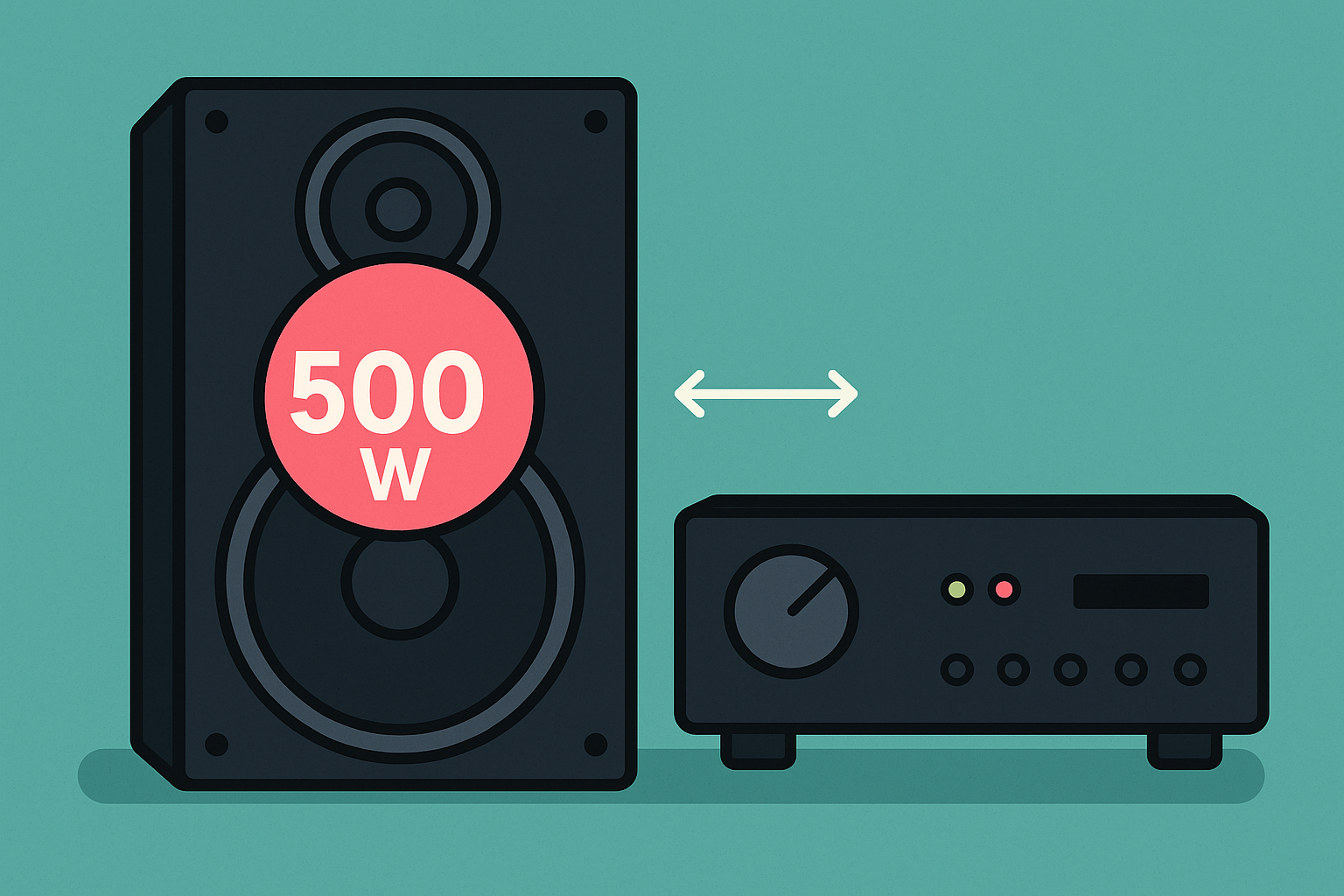
What Size Amp Do You Need for 500 Watt Speakers?

You’ve got a pair of 500 watt speakers and you’re wondering what kind of amp will make them sing. Choosing the right amp is key to getting the best sound and protecting your gear. Let’s break down what you need to know so you can make the right choice.


Understanding Speaker and Amp Power Ratings

First, look at your speaker’s specs. You’ll see numbers like “500 watts RMS” and maybe “800 watts max.” RMS stands for “Root Mean Square,” which is the real continuous power your speaker can handle. Max power is just a peak rating, not what your speaker uses all the time.

Your amp’s power rating should match or exceed your speaker’s RMS rating. This helps avoid distortion and keeps your system safe. If your speakers are 500 watts RMS, your amp should ideally be at least 500 watts per channel. But most experts suggest going a bit higher for the best results.


Why Overpowering Your Speakers Can Be a Good Thing

You might think using an amp with more power than your speakers is risky. Actually, it’s the opposite. An amp that’s too weak can cause distortion, which can damage your speakers. When you push a small amp too hard, it clips the signal. Clipping creates harsh sounds and can blow out your speakers faster than you think.

A common rule is to use an amp with 1.5 to 2 times your speaker’s RMS rating. For 500 watt speakers, that means an amp between 750 and 1000 watts per channel. This extra power is called “headroom.” Headroom lets your amp handle sudden loud sounds without straining. It also makes your music sound clearer and more dynamic.

Imagine your amp as a car engine. If you always drive at full speed, your engine wears out fast. With extra power, you can cruise easily and handle hills without stress. It’s the same with amps and speakers.


How to Match Your Amp to Your Speakers

Now, let’s talk about how to match your amp to your 500 watt speakers. Here’s a simple step-by-step guide:

  1. Check Your Speaker’s RMS Rating
    Your speakers should say “500 watts RMS.” That’s the number you care about.
  2. Find an Amp with Enough Power
    Look for an amp that’s at least 500 watts per channel at the same impedance as your speakers. If you want headroom, go for 750 to 1000 watts per channel.
  3. Look at Impedance
    Your speakers might say “8 ohms” or “4 ohms.” Make sure your amp can handle that impedance. Using the wrong impedance can damage your gear.
  4. Consider Your Needs
    Think about where you’ll use your system. For home use, you might not need the full 500 watts. For live sound or big parties, you’ll want every watt you can get.

Here’s a quick table to help you match your amp to your speakers:

Speaker RMS PowerMinimum Amp PowerIdeal Amp Power
500 watts500 watts750–1000 watts

What Happens If You Use a Smaller Amp?

You can technically use a smaller amp with your 500 watt speakers. For example, a 50 or 100 watt amp will work, but you won’t get the full potential of your speakers. You’ll also risk distortion if you turn the volume up too high.

High-sensitivity speakers (like many PA speakers) can get very loud even with a small amp. But if you want clean, powerful sound, a bigger amp is the way to go. If you only use your system at low volumes, a smaller amp is fine. For big events or loud music, you need the extra power.


How Loud Will Your System Be?

With 500 watt speakers and a matching amp, you can get seriously loud. For example, if your speakers have a sensitivity of 98 dB (which is common for PA speakers), they’ll be very loud even with a small amp. With a 50 watt amp, you can reach 115 dB at 1 meter, which is enough to damage your hearing.

But with a 500 watt amp, you can fill a large room or outdoor space with sound. If you’re playing in a club, auditorium, or at a party, this is the power you need. For home use, you’ll rarely need to use all that power, but it’s nice to have it when you want it.


Practical Tips for Choosing Your Amp

Here are some practical tips to help you pick the right amp for your 500 watt speakers:

  • Always match or exceed the RMS rating of your speakers for the best sound and safety.
  • Look for headroom—an amp with 1.5 to 2 times your speaker’s RMS rating is ideal.
  • Check the impedance to make sure your amp and speakers are compatible.
  • Consider your usage—home, party, or live sound? Choose your amp power accordingly.
  • Avoid distortion—never push a small amp too hard. It’s better to have extra power than not enough.

Real-World Examples

Let’s look at some real-world situations:

  • Home Stereo: You probably don’t need 500 watts per channel at home. A 100–200 watt amp is plenty for most rooms.
  • Small Party or Coffee Shop: 250–500 watts per channel will give you plenty of volume.
  • Club or Auditorium: 500–1000 watts per channel is ideal for loud, clear sound.
  • Outdoor Festival: You might need 1000 watts or more per channel to cover a big area.

What About Multiple Speakers?

If you’re using more than one speaker per channel, you need to adjust your amp power. For example, if you connect two 500 watt speakers to one channel, your amp should be able to handle 1000 watts at that impedance. Always check your amp’s specs for multi-speaker setups.


Common Myths and Mistakes

There are a few myths about matching amps and speakers. Here’s what you should know:

  • Myth: Using a bigger amp will blow your speakers.
    Truth: As long as you don’t turn the volume up too high, a bigger amp is safer than a small one.
  • Myth: You need an amp with the exact same wattage as your speakers.
    Truth: It’s better to have extra power for headroom and cleaner sound.
  • Myth: Impedance doesn’t matter as long as the wattage matches.
    Truth: Impedance must match to avoid damage and get the best performance.

So What Size Amp Do You Need?

Matching your amp to your 500 watt speakers is easier than you think. Just remember to match or exceed the RMS rating, look for headroom, and check the impedance. With the right amp, your speakers will sound amazing and last for years.

Whether you’re setting up a home theater, a party system, or a live sound rig, the right amp makes all the difference. Now you know exactly what size amp you need for your 500 watt speakers. Happy listening!

How to Match Your Amp Wattage to Speaker Wattage (Without Blowing Anything Up)

You’ve got the speakers. You’ve got the amp. Now, how do you make sure they play nice together? Matching amp and speaker wattage isn’t just about avoiding smoke signals-it’s about unlocking crystal-clear sound. Let’s break it down like a playlist, minus the skips.


Why Wattage Matching Matters (And Why It’s Not Rocket Science)

Think of your speaker’s wattage as its “max caffeine intake.” Go overboard, and it’ll fry. Stay too low, and it’ll underwhelm. Speakers list two key specs: RMS (continuous power handling) and peak (short-burst tolerance). Your amp’s RMS per channel should at least match your speaker’s RMS.

Here’s the sweet spot: Aim for an amp that delivers 1.5–2x your speaker’s RMS wattage. Why? Headroom. Like a safety net, extra power prevents distortion when bass drops or vocals soar. But don’t go overboard-a 100W speaker paired with a 200W amp is like feeding a goldfish a family-size pizza.


The Impedance Tango: Ohms Aren’t Just for Yoga

Impedance (measured in ohms) is your speaker’s electrical “resistance.” Most home speakers sit at 4–8 ohms. Your amp’s manual will list compatible impedance ranges-stray outside these, and you risk overheating or muffled sound.

  • Match the numbers: If your speakers are 8 ohms, use an amp rated for 8 ohms.
  • Series vs. parallel: Wiring multiple speakers? Calculate total impedance to avoid surprises.

Pro tip: Lower impedance (e.g., 4 ohms) lets your amp deliver more power-but only if it’s designed to handle it.


Sensitivity: The Secret Sauce for Louder Sound (Without More Watts)

Speaker sensitivity (measured in dB) tells you how loud a speaker gets with 1 watt of power at 1 meter away. A 90dB speaker needs 10 watts to hit 100dB-the volume of a motorcycle. A 100dB speaker? Just 1 watt.

  • High sensitivity (90dB+): Perfect for low-wattage amps (e.g., 20W tube amps).
  • Low sensitivity (85dB or less): Pair with beefier amps (100W+) to fill larger rooms.

The “Twice as Powerful” Myth Debunked

You’ve heard it: “Your amp should be twice your speaker’s wattage!” This myth stems from avoiding distortion, but it’s not a hard rule. Modern amps and speakers are more forgiving. Instead:

  1. Use the 1.5x guideline for headroom.
  2. Watch for clipping (distortion sounds like static)-it means your amp is struggling.
  3. Volume habits matter. Crank it to 11 daily? Lean toward 2x wattage.

Your Matching Cheat Sheet

Speaker SpecAmp Wattage Sweet SpotWatch Out For
50W RMS, 8 ohms75–100W per channelLow impedance amps
100W RMS, 4 ohms150–200W per channelOverheating
High sensitivityLower wattage worksUnderpowering

Trust Your Ears (Yes, Really)

Specs guide you, but your ears have the final say. If your system sounds clean at your preferred volume, you’ve nailed it. Now, go make those neighbors jealous-responsibly

How Many Watts Is a Good Amplifier?

When choosing an amplifier for your audio system, understanding the power output is crucial. The question, “How many watts is a good amplifier?” can seem simple at first glance, but the answer depends on various factors, including your needs, speaker efficiency, and the environment in which the amplifier will be used. This article will guide you through understanding amplifier wattage, its implications for sound quality, and how to choose the right wattage for different applications.

What Does Amplifier Wattage Mean?

Wattage refers to the power output of an amplifier, measured in watts (W). It is a key indicator of how much power the amplifier can deliver to drive speakers. Essentially, higher wattage means the amplifier can drive speakers louder without distortion.

How Many Watts Is Sufficient for Home Use?

For most home audio setups:

  • Casual Listeners: A 20-50 watt per channel amplifier is usually sufficient for moderate volume levels in a small to medium-sized room. This power range is ideal for background music and casual listening.
  • Audiophiles: For those who desire high-fidelity sound and greater detail, a 50-100 watt per channel amplifier is recommended. This ensures clear, distortion-free sound even at higher volumes.

The Relationship Between Wattage and Volume

Understanding the logarithmic nature of sound is essential:

  • Decibels (dB): Sound is measured in decibels, and every 10 dB increase is perceived as twice as loud. However, to achieve this, you need approximately ten times more power. For example, going from 10W to 100W doesn’t make the system ten times louder but noticeably increases the volume without distortion.

Matching Amplifier Wattage with Speaker Sensitivity

Speaker sensitivity is measured in decibels (dB) and indicates how loud a speaker will play with 1 watt of power at a 1-meter distance.

  • Low Sensitivity Speakers (under 86 dB): These require more power, typically 50-100 watts or more, to deliver adequate volume.
  • Moderate Sensitivity Speakers (87-92 dB): These perform well with a 20-50 watt per channel amplifier.
  • High Sensitivity Speakers (over 92 dB): These can achieve substantial volume levels with just 10-20 watts per channel.

Wattage for Different Listening Environments

  • Small Rooms (e.g., bedrooms, small offices): Typically, 20-40 watts per channel is sufficient due to limited space and lower volume requirements.
  • Medium-Sized Rooms (living rooms): 50-80 watts per channel offers good headroom for dynamic peaks, ensuring clear sound at moderate to high volume.
  • Large Spaces (open-concept rooms, outdoor spaces): For larger areas or outdoor setups, look for amplifiers with 100 watts or more per channel to ensure that the sound projects well without distortion.

High Power vs. Low Power: Which Is Better?

More wattage doesn’t always equate to better sound:

  • High-Power Amplifiers: Can deliver clearer sound at higher volumes and handle sudden dynamic changes, such as explosions in movies or crescendos in music.
  • Low-Power Amplifiers: Ideal for users with efficient speakers or those who prefer lower volume levels. They are also well-suited for audiophiles who value sound quality over raw volume.

What Are RMS and Peak Power Ratings?

When evaluating amplifier power:

  • RMS (Root Mean Square): Represents the continuous power an amplifier can produce. It’s the most reliable measure for comparing amplifiers.
  • Peak Power: Refers to the maximum power output an amplifier can achieve for a short duration. This figure is less critical than RMS for everyday use.

Example: An amplifier rated at 100 watts RMS per channel can consistently deliver 100 watts without distorting. If it has a peak power rating of 150 watts, it can temporarily handle bursts of 150 watts.

Consideration of Total Harmonic Distortion (THD)

An important metric often overlooked is THD, which measures how much distortion the amplifier introduces at a given wattage:

  • Low THD (< 0.1%): Results in cleaner sound quality. High THD (> 0.5%): Audible distortion may become noticeable, especially at higher volumes.

Solid-State vs. Tube Amplifiers

  • Solid-State Amplifiers: Typically deliver high wattage with low distortion, are more durable, and require less maintenance.
  • Tube Amplifiers: Known for warm sound and musical distortion, tube amplifiers often require less wattage to produce perceived loudness due to the way they handle distortion.

How Many Watts Are Enough for Portable or Bluetooth Speakers?

Portable speakers operate at much lower wattages than home audio systems. For example:

  • Compact Bluetooth Speakers: Usually range from 3 to 20 watts, sufficient for personal or small group listening.
  • Larger Portable Units: Models designed for parties or outdoor gatherings can reach up to 100 watts or more for better sound projection.

Key Takeaways When Choosing an Amplifier

  • Identify Your Use Case: For casual home listening, 20-50 watts per channel suffices. For audiophiles or home theater setups, 50-100 watts or more is ideal.
  • Check Speaker Sensitivity: Match your amplifier’s wattage with the sensitivity of your speakers.
  • Room Size Matters: Consider the size of the space where the amplifier will be used; larger spaces need more wattage for optimal sound projection.
  • Prioritize RMS Power Ratings: Ensure the amplifier’s RMS rating matches your needs rather than peak power.

FAQs About Amplifier Wattage

What’s the difference between RMS and peak wattage?

RMS indicates the continuous power an amplifier can produce, while peak wattage is the maximum it can handle for short bursts.

Can too much wattage damage speakers?

Yes, amplifiers with significantly more power than a speaker’s rated capacity can cause damage. Always match the power output to your speaker specifications.

Are tube amplifiers better than solid-state amplifiers?

It depends on preference. Tube amplifiers offer warm, vintage sound, while solid-state amplifiers are known for their reliability and power efficiency.

What wattage is needed for home theater systems?

Typically, 50-150 watts per channel is ideal for most home theater systems, depending on room size and desired volume.

How do I know if my amplifier is powerful enough?

Ensure the amplifier can drive your speakers without distortion at your preferred listening level, and check the RMS rating.

Does higher wattage mean better sound quality?

Not necessarily. Higher wattage allows for louder sound without distortion but doesn’t inherently mean better sound quality.


Choosing the right wattage for an amplifier comes down to understanding your specific needs, the sensitivity of your speakers, and the listening environment. By considering these factors and paying attention to reliable wattage ratings like RMS, you can find an amplifier that delivers the sound quality and volume you desire.