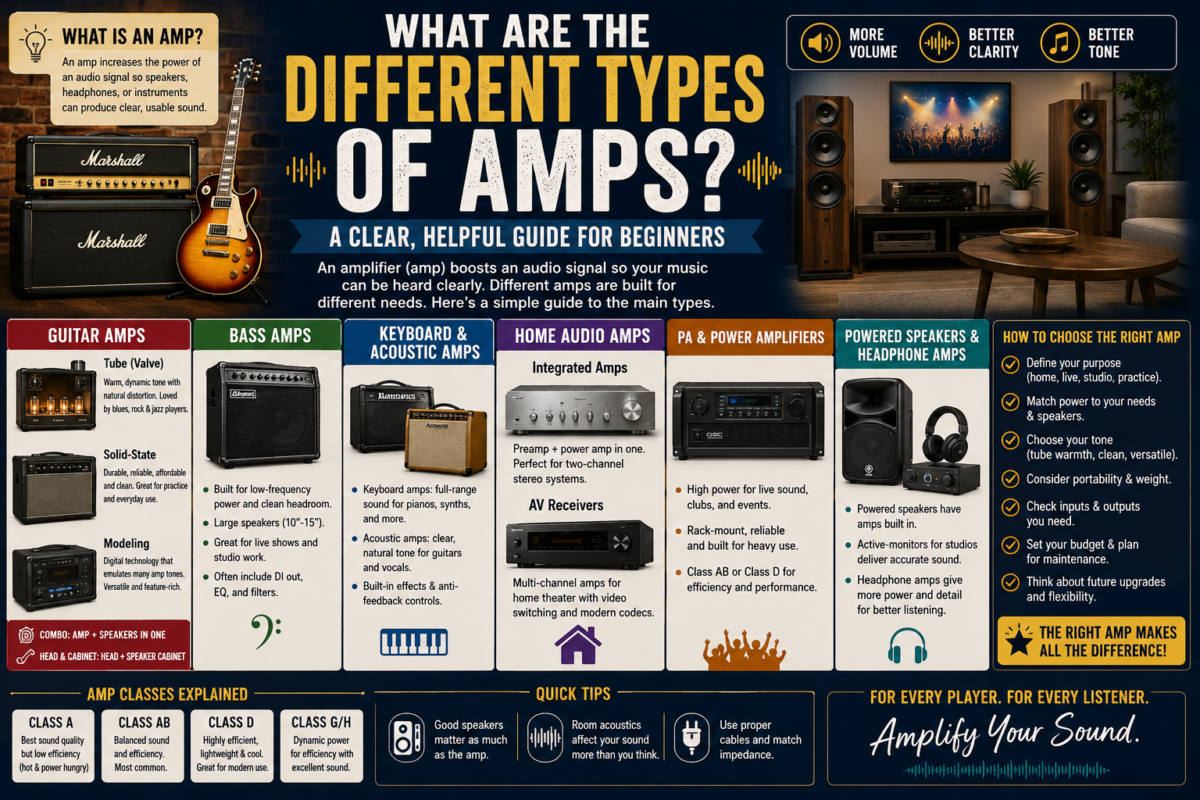
If you’ve ever shopped for audio gear, watched musicians set up at a gig, or tried to upgrade your home sound system, you’ve probably run into the term “amp” a lot. Short for amplifier, an amp takes a small audio signal and boosts it so speakers, headphones, or instruments can be heard clearly. But not all amps are the same — they come in different designs, sizes, and purposes. This guide explains the main types of amplifiers, what each one does, and how to choose the right amp for your needs. It’s written simply, with a light tone, and focused on answering the questions people ask when searching for informational help.
What is an amplifier and why does it matter?
An amplifier increases the power of an audio signal. Without adequate amplification, sound from a guitar, microphone, or audio player would be too quiet to be useful. Amps influence volume, clarity, tonal character, and how well speakers perform. Different amps are optimized for different tasks — instrument performance, home listening, studio recording, or live sound reinforcement.
Broad categories: analog vs. digital, integrated vs. separate
Before diving into the specific amp types, it helps to understand two basic contrasts:
- Analog vs. digital: Analog amps use continuous electrical signals and traditional circuitry (tubes or transistors). Digital amps (also called class-D or modeling amps) use digital processing and can be highly efficient and feature-rich.
- Integrated vs. separate: An integrated amp combines a preamplifier and power amplifier in one box (common in home audio). In professional or hi-fi setups, preamps and power amps are often separate units to provide more control and upgrade flexibility.
Now let’s look at the specific types you’ll encounter.
- Guitar amps — tube (valve), solid-state, and modeling
Guitar amps are a world on their own because players want tone as much as volume.
- Tube (valve) amps: These use vacuum tubes to amplify the signal. They’re prized for warm, natural-sounding distortion, smooth dynamics, and pleasing harmonic overdrive when pushed. Many blues, rock, and jazz players prefer tube amps for their musical response. Downsides: heavier, require maintenance, can be expensive.
- Solid-state amps: Use transistor-based circuitry. They’re durable, lighter, more affordable, and require less upkeep. Solid-state amps are often cleaner and more consistent, though earlier designs were criticized for sounding “sterile.” Modern solid-state units can be excellent and are commonly used for practice and budget-conscious players.
- Modeling amps: Use digital signal processing (DSP) to emulate the sounds of many classic amps and effects. They’re versatile, compact, and ideal for players who need dozens of tones without hauling multiple amps. Modeling amps are popular for home practice, studio work, and versatile gigging. Examples include combos and amp heads with onboard presets and USB connectivity.
Common formats
- Combo amps: Amp and speaker(s) in one enclosure. Portable and popular for practice and small gigs.
- Amp heads and cabinets: Head contains the electronics; cabinet holds the speakers. Preferred for stage flexibility and larger setups.
- Bass amps
Bass amplifiers are designed to handle low-frequency content and typically emphasize clean headroom and power rather than distortion.
- Bass combo and head/cabinet systems: Similar in form to guitar amps but engineered for deep lows and high-power delivery. They often have larger speakers (10–15 inches), EQ suited to bass frequencies, and strong low-end response.
- Amp features: Compression, notch filters, and DI outputs for sending a clean signal to the PA or recording interface.
- Instrument amplifiers beyond guitar and bass
Amps tailored for keyboards, acoustic guitars, and orchestral instruments address specific needs:
- Keyboard amps: Full-range speakers and flat frequency response to reproduce synths, pianos, and sample-based sounds accurately. They often include multiple inputs and effects loops.
- Acoustic amps: Designed to reproduce the natural tone of acoustic guitars and voices with clarity. Many include anti-feedback controls, built-in effects (reverb), and a mix channel for vocals.
- Acoustic-electric combos: Combine mic/line inputs, EQ, and sometimes a small PA-like functionality for singer-songwriters.
- Home audio amplifiers — integrated, stereo, and AV receivers
Home audio amps aim for accurate music reproduction and ease of use.
- Integrated amplifiers: Combine preamp and power amp sections in one chassis. They feed passive speakers and usually include volume, tone controls, source switching, and sometimes phono inputs for turntables. Ideal for two-channel music systems.
- Stereo power amplifiers: Only provide amplification; require a separate preamp or controller. Audiophiles prefer separates for higher fidelity and upgrade paths.
- AV receivers: Built for home theaters and multi-channel audio. They include surround-sound decoding, video switching, network streaming, and room calibration tools. AV receivers are a central hub for home entertainment systems.
- Specialized headphone amplifiers: Small units that drive high-impedance headphones better than standard headphone jacks. Audiophiles and studio engineers often use dedicated headphone amps for improved detail and dynamics.
- Power amplifiers for PA and professional sound
These amplifiers deliver high power to large speaker systems in live events, clubs, and houses of worship.
- Stereo power amps and multi-channel power amps: Built for high continuous output and reliability. They often include bridging modes, protection circuits, and cooling systems.
- Amplifier types by class: Class AB is common for clean sound and moderate efficiency; Class D is highly efficient and used when weight and heat are concerns (touring rigs, powered speakers).
- Rack-mount amplifiers: Designed for use in standard 19-inch equipment racks; common for touring, installations, and fixed sound systems.
- Powered speakers and active monitors
These units have amplifiers built into the speaker enclosure, simplifying setup.
- Active studio monitors: Designed for near-field monitoring with flat frequency response for mixing and mastering. Each speaker contains its own amp(s) matched to the drivers.
- Powered PA speakers: Offer onboard amplification and processing, used for quick setup and live sound reinforcement. They often include DSP for EQ, limiting, and speaker protection.
- Headphone amplifiers and DAC/amp combos
Especially for personal listening and portable setups, headphone amps improve dynamics, volume headroom, and sound quality.
- Portable headphone amps: Small battery or USB-powered devices that boost headphone performance for phones or laptops.
- Desktop DAC/amp combos: Convert digital audio to analog (DAC) and amplify it. These are common for home desktop listening, offering both better conversion and stronger driving power than integrated sound cards.
- Class distinctions: A, AB, D, G, H, etc. — what they mean
Amp “classes” describe the amplifier topology and affect efficiency, heat, and sound character.
- Class A: All output devices conduct during the entire waveform. Best linearity and low distortion, but very inefficient and hot.
- Class AB: Combines Class A’s linearity near the waveform center and Class B’s efficiency at higher outputs. Popular in hi-fi and pro amps.
- Class D: Uses high-frequency switching and filtering for very high efficiency and compact size. Modern Class D amps can sound excellent and are ideal for powered speakers and portable systems.
- Class G/H: Use multiple rails or dynamic rail switching to improve efficiency compared to AB while maintaining good sound quality.
- Other classes (B, C, T): Less common in audio playback; C is used in RF amplifiers, T is a marketing term for certain switching designs.
- Special-purpose amplifiers
Some amps serve niche roles or add features beyond simple amplification.
- Tube preamps and power sections: Tube preamplifiers or power amp sections are used in hi-fi or guitar rigs to add harmonic character.
- Instrument-specific preamps: Mic preamps for studio microphones, DI boxes with preamp sections for instruments, and microphone-powered small preamps.
- Hybrid amps: Combine tube preamp sections with solid-state power sections to get tube warmth with modern reliability.
- Modeling and profile amps: For guitarists who want digital capture of amp characteristics (IRs and profiles) and tone-shaping tools for studio and live use.
- How to choose the right amp — checklist
This short checklist answers common search intent: people want a simple way to pick an amp.
- Define purpose: home listening, studio monitoring, live PA, instrument practice, or gigging.
- Match power to needs: For small rooms, 10–50 watts may suffice for guitar combos; for larger venues, you’ll need more power or a PA. Speaker sensitivity matters for actual loudness.
- Consider tone preference: Warm and dynamic (tube), clean and reliable (solid-state), or versatile and preset-rich (modeling).
- Portability and weight: Tube and AB amps are heavier; Class D and modeling amps are lighter.
- Inputs and outputs: Do you need DI out, effects loop, line inputs, USB, or Bluetooth?
- Budget and maintenance: Tubes require eventual replacement; solid-state and Class D generally need less upkeep.
- Room acoustics and speakers: An amp can only do so much; good speakers and room treatment affect final sound more than incremental amp tweaks.
- Common FAQs people search for
- Are tube amps better than solid-state? “Better” depends on taste. Tube amps are prized for their character and natural distortion, while solid-state amps are reliable, lighter, and often more affordable.
- Can I use an amp with any speaker? Only if the amp and speaker impedance and power ratings are compatible. Mismatched impedance can damage equipment.
- Do powered speakers need an amp? No, powered (active) speakers have amps built in. Passive speakers need an external amp.
- What wattage do I need? Wattage needs depend on speaker efficiency and room size. Higher wattage gives more headroom and cleaner sound at high volumes.
- Are Class D amps inferior? No. Modern Class D amps are efficient and can sound excellent; they’re especially useful where weight and heat are concerns.
- Quick buying tips for different users
- Beginner musician: Start with a small combo (20–40W solid-state or modeling) for home practice and portability.
- Gigging musician: Choose power and portability, consider a head/cabinet for flexibility or a high-watt combo; look for DI outs for PA integration.
- Home audiophile: Consider separates or a high-quality integrated amp, and focus on speaker matching and room treatment.
- Home theater builder: Choose an AV receiver with the right number of channels and modern codecs (Dolby Atmos, DTS:X) and HDMI features.
- Podcaster/streamer: Invest in an audio interface or mixer with quality preamps; headphone amp/DAC combos help with monitoring clarity.
- Studio engineer: Use accurate active monitors with dedicated monitor amps (or powered monitors), and keep preamps and converters high quality.
Which amp type should you care about?
- For guitarists: tube, solid-state, or modeling guitar amps depending on tone and budget.
- For bassists: powerful, clean bass amps that handle low frequencies.
- For home audio listeners: integrated amps or AV receivers, depending on two-channel vs. home theater needs.
- For live sound and PA: robust power amplifiers and powered speakers for simplicity.
- For studios: active studio monitors, quality headphone amps, and precise preamps.
Final practical example
If you’re a beginner guitarist who wants a single solution for practice, recording, and casual gigging: choose a 20–40W modeling combo with USB output and headphone jack. It’s versatile, light, lets you record directly to your computer, and offers amp presets so you can experiment without buying extra gear.
If you want a deeper recommendation tailored to your exact use (room size, instrument, budget), tell me those details and I’ll suggest specific amp types and models that fit.