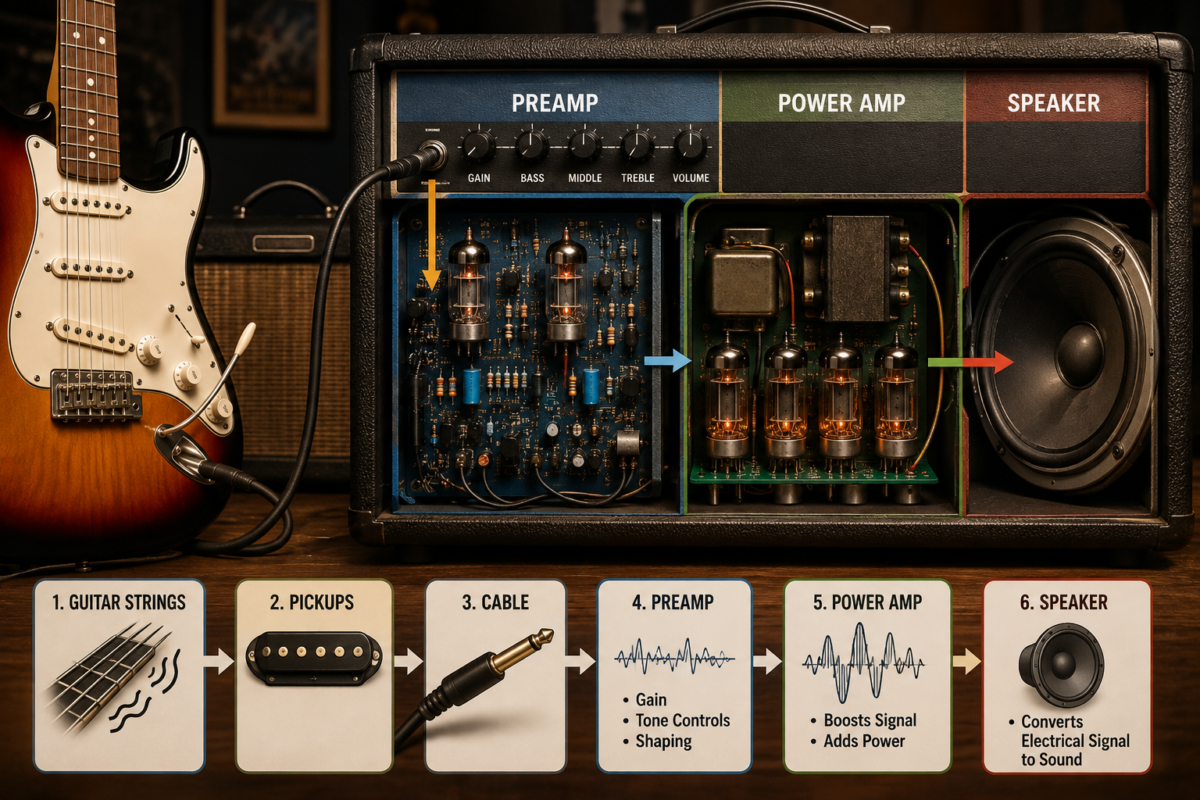
An electric guitar can make a sound without an amplifier, but that sound is usually quiet, thin, and difficult to hear across a room. A guitar amplifier takes the small electrical signal created by the guitar’s pickups, strengthens it, shapes its tone, and sends it to a speaker that turns it into the loud sound musicians recognize.
A guitar amplifier does much more than make a guitar louder. It helps create the instrument’s personality. The same guitar can sound clean, warm, bright, gritty, heavy, or distorted depending on the amplifier, its settings, and how hard the player pushes the circuit.
The basic signal path is simple:
Guitar strings → pickups → cable → preamp → tone controls → power amp → speaker → sound
Let’s look at what happens at each stage.
What a Guitar Pickup Does
Before a guitar amplifier can do anything, the guitar must create an electrical signal. This is the job of the pickups.
Electric guitar strings are usually made from magnetic metal. A pickup contains magnets wrapped with a coil of thin copper wire. When a metal string vibrates above the pickup, it disturbs the pickup’s magnetic field. That movement creates a small changing electrical signal in the coil.
This signal follows the same pattern as the vibrating string. If you play a low note, the signal oscillates at a lower frequency. If you play a high note, it oscillates at a higher frequency. The strength of the signal also changes depending on how hard you pick the string.
The pickup does not produce a powerful signal like the one needed to drive a speaker. It produces a relatively weak signal that carries the basic information about your playing:
- The pitch of the note.
- The volume of the note.
- The timing of the note.
- The attack created by your pick or fingers.
- Some of the tonal character of the guitar.
Single-coil and humbucking pickups create different types of signals. Single-coil pickups often produce a bright, clear, and sharp tone, while humbuckers generally produce a thicker and fuller sound. However, the amplifier has a major influence on the final result.
When you plug the guitar cable into the amplifier’s input, this small pickup signal enters the first major section: the preamp.
How the Preamp Shapes the Sound
The preamp, or preamplifier, is the first active section inside most guitar amplifiers. Its main job is to boost the weak signal from the guitar and prepare it for the power amplifier.
The preamp is also where much of the amplifier’s character is created. It contains gain stages, tone controls, equalization circuits, and sometimes built-in effects. The preamp helps determine whether an amplifier sounds clean, warm, bright, compressed, gritty, or aggressive.
The Gain Control
The gain control determines how strongly the guitar signal is pushed through the preamp.
At a low gain setting, the signal remains relatively clean. The amplifier increases the signal without changing its shape very much. This produces a clear sound with good note separation.
As you increase the gain, the signal becomes stronger. Eventually, it may become too large for a particular circuit to reproduce accurately. The peaks of the waveform are compressed or clipped. This creates overdrive or distortion.
That familiar crunchy guitar sound is often produced by deliberately overloading one or more preamp stages. The result can range from mild bluesy breakup to thick, high-gain metal distortion.
Gain and volume are not always the same thing. Gain controls how hard the preamp is driven, while the master volume controls how loud the signal becomes later in the amplifier. You can have high gain at a relatively low volume, or low gain at a loud volume.
The Tone Controls
Most guitar amplifiers include bass, middle, and treble controls. These controls form part of the tone section, often called the tone stack.
The bass control affects low frequencies. Increasing it can make the sound deeper and fuller, but too much bass may make the tone muddy.
The middle control affects the central range of frequencies where much of the guitar’s body and clarity are found. Reducing the mids can create a scooped sound, while increasing them can help the guitar stand out in a full band mix.
The treble control affects high frequencies. More treble can add brightness, bite, and definition. Too much, however, may make the sound harsh or unpleasant.
Some amplifiers also include presence, resonance, contour, or bright switches. These controls may operate in different parts of the circuit and can affect the overall response of the amplifier.
Why the Preamp Matters
The preamp is not simply a volume booster. It decides how the guitar signal is shaped before it reaches the power amp. This is why two amplifiers with the same wattage can sound completely different.
One amplifier may have a bright and glassy preamp, while another may produce thick midrange and early overdrive. The design of the circuit, the components used, and the way the controls interact all contribute to the amplifier’s sound.
After the signal has been boosted and shaped by the preamp, it moves to the power amplifier.
How the Power Amp Makes the Signal Strong
The power amplifier is responsible for increasing the signal’s power to a level that can drive a speaker.
The preamp creates and shapes the tone, but its output is still not powerful enough to move a large speaker cone. The power amp takes that processed signal and produces a much stronger version of it. This stage uses energy from the amplifier’s power supply to create enough electrical power for the speaker.
The master volume is commonly connected to this part of the signal path, although the exact design varies between amplifiers.
When the power amp is operating within its limits, it reproduces the preamp signal with greater strength. When it is pushed hard, the power amp itself can begin to compress and distort the sound.
This type of distortion can feel different from preamp distortion. Power amp overdrive is often described as more open, responsive, and dynamic. It may become louder and more distorted when the player picks harder, then clean up when the player plays softly.
In a traditional tube amplifier, the power section may also produce compression and a temporary response known as sag. Sag happens when the power supply voltage briefly drops under heavy demand. Many guitarists enjoy the softer feel and natural response this can create.
How the Speaker Turns Electricity Into Sound
The speaker is the final major stage of a guitar amplifier. It changes the powerful electrical signal from the power amp into air movement that your ears detect as sound.
A typical guitar speaker contains a cone, voice coil, magnet, and suspension system. When the amplified electrical signal reaches the voice coil, the coil interacts with the magnetic field. This causes the coil and attached cone to move back and forth.
As the cone moves, it pushes and pulls the surrounding air. These changes in air pressure travel through the room as sound waves.
The speaker does not reproduce every frequency equally. It has its own response, character, and limitations. This makes the speaker an important part of the guitar tone rather than a neutral delivery system.
A guitar speaker may add midrange focus, soften high frequencies, compress certain notes, or respond differently depending on the volume. The speaker cabinet also affects the sound by influencing resonance, projection, and bass response.
This is why changing a speaker can transform an amplifier even when the electronic circuit remains the same.
Tube, Solid-State, and Modeling Amplifiers
Guitar amplifiers use different technologies to boost and shape the signal. The three most common categories are tube, solid-state, and modeling amplifiers.
Tube Amplifiers
Tube amplifiers use vacuum tubes, also called valves, in their preamp and power amp sections. A vacuum tube controls the flow of electrons through a vacuum, allowing it to amplify the guitar signal.
Tube amplifiers are popular because of the way they respond when played. Many musicians describe them as warm, lively, touch-sensitive, and dynamic. They can remain clean at lower levels and gradually develop natural compression and overdrive as they are pushed.
Different tubes and circuit designs create different responses. Some tube amplifiers are known for sparkling clean tones, while others are designed for thick overdrive and powerful distortion.
Tube amplifiers also have disadvantages. They are often heavier, more expensive, and more fragile than other types. The tubes eventually wear out and may need replacement. Tube amplifiers also generate heat and usually require more care during transport.
A tube amplifier should never be operated incorrectly without a proper speaker load. If a separate tube amplifier head is used with a cabinet, the amplifier and cabinet must be connected correctly. An impedance mismatch can damage the amplifier.
Solid-State Amplifiers
Solid-state amplifiers use transistors and other semiconductor components instead of vacuum tubes.
They are typically lighter, more affordable, and more reliable than tube amplifiers. They can also produce a consistent tone without requiring regular tube replacement.
Solid-state circuits can provide clean, clear sounds with plenty of volume. Some are designed to remain clean even when played loudly. Other models use special circuits to imitate the response of an overdriven tube amplifier.
Older solid-state amplifiers sometimes developed a reputation for harsh distortion when pushed too far. Modern designs have improved significantly, and many solid-state amplifiers are valued for their reliability, clean tone, and practical features.
Modeling Amplifiers
Modeling amplifiers use digital signal processing to recreate the behavior of different amplifiers, speaker cabinets, microphones, and effects.
Inside the amplifier, software analyzes and processes the guitar signal. Instead of relying on one physical preamp and power amp design, a modeling amplifier may offer many virtual choices.
A single modeling amp might imitate classic clean amplifiers, British-style crunch, modern high-gain sounds, bass amps, acoustic preamps, and effects such as delay, reverb, chorus, and tremolo.
Modeling technology is useful for guitarists who need several sounds in one unit. It is also convenient for practice, recording, and performing with headphones or a direct connection to a sound system.
The quality of modeling amplifiers varies, but modern digital systems can produce convincing results. Many units also allow players to save presets and control sounds with footswitches.
Hybrid Amplifiers
Hybrid amplifiers combine different technologies. For example, an amplifier may use a tube in the preamp and a solid-state power amp. Another may use a digital modeling preamp with a traditional power section.
Hybrid designs aim to combine selected advantages, such as tube-like tone, lower weight, greater reliability, or a wider range of sounds.
Combo Amps and Separate Rigs
A combo amplifier includes the amplifier electronics and speaker in one cabinet. It is usually the simplest option for beginners and players who want an easy setup.
You connect the guitar, plug in the amplifier, adjust the controls, and start playing. Combo amps are available in small practice sizes and powerful stage models.
A separate head-and-cabinet system places the amplifier electronics in one unit and the speaker cabinet in another. This arrangement allows players to combine different heads and cabinets.
A head may offer the desired preamp and power amp character, while a cabinet may provide a particular speaker configuration. A setup could include one speaker, two speakers, or four speakers.
Separate rigs can be flexible, but they require more attention. The head and cabinet must be compatible, especially when using a tube amplifier. The amplifier’s output impedance should match the cabinet’s rated impedance as closely as the manufacturer recommends.
What Guitar Amp Watts Mean
Wattage describes the amplifier’s power output, not an exact measurement of loudness.
A higher-wattage amplifier can generally produce more clean headroom before its power section begins to distort. A lower-wattage amplifier may reach power amp breakup at a lower volume, which can be useful for home recording or small performances.
More watts do not automatically mean a better amplifier. A small amplifier can be ideal for practice, while a larger amplifier may be better for a loud band or a large venue.
Speaker efficiency, cabinet design, room size, and the drummer’s volume all affect how loud an amplifier feels. A 20-watt tube amplifier can be surprisingly loud, while a 50-watt amplifier may not sound twice as loud to the listener.
This is because perceived loudness does not increase in a simple one-to-one relationship with wattage. Choosing the right power level is usually about the amount of clean volume, desired breakup, portability, and playing environment.
Why Guitar Amps Distort
Distortion happens when the amplifier is asked to reproduce a signal beyond what part of its circuit can handle cleanly.
Imagine a smooth wave entering the amplifier. If the signal becomes too large, the circuit may flatten the tops and bottoms of the wave. This changes the original shape and adds extra harmonics.
Those added harmonics create the sound of overdrive and distortion.
Distortion can occur in several places:
- The preamp may clip when the gain is turned up.
- The power amp may distort when the master volume is raised.
- The speaker may compress or break up at high volume.
- A pedal may intentionally distort the signal before it reaches the amplifier.
The type of distortion depends on the circuit and how it clips the signal. Gentle clipping can sound smooth and warm, while abrupt clipping can sound aggressive and sharp.
What Effects Loops Do
Many guitar amplifiers include an effects loop. This provides a connection between the preamp and power amp sections.
Instead of plugging every effect into the amplifier’s main input, some effects can be placed in the loop. Time-based effects such as delay and reverb often sound clearer there, especially when the amplifier’s preamp is producing heavy distortion.
A typical signal path may look like this:
Guitar → overdrive pedal → amplifier input → preamp distortion → effects loop → delay or reverb → power amp → speaker
Not every guitarist needs an effects loop. Some players prefer running every pedal into the front of the amplifier. The best choice depends on the amplifier, effects, and desired tone.
Why the Same Settings Sound Different
An amplifier’s controls do not work in isolation. The guitar, pickups, strings, cable, pedals, room, speaker, cabinet, and playing technique all influence the final sound.
A humbucker may push the preamp harder than a lower-output single-coil pickup. A bright guitar may require less treble than a dark-sounding guitar. A closed-back cabinet may produce a tighter response than an open-back cabinet.
Your playing also matters. Picking near the bridge usually creates a brighter sound, while picking closer to the neck can produce a warmer tone. Playing softly may keep the amplifier clean, while striking the strings harder may create more overdrive.
This interaction is one reason guitar amplifiers feel like part of the instrument. They do not simply make a finished sound louder. They react to the signal and help shape what the guitarist expresses.
A Simple Example of the Full Process
Suppose you play a note on an electric guitar.
First, the string vibrates inside the magnetic field of the pickup. The pickup converts that vibration into a small electrical signal.
Next, the signal travels through the guitar cable and enters the amplifier’s preamp. The preamp boosts the signal and adjusts its tone according to the gain, bass, middle, treble, and other controls.
If the gain is high, the preamp may clip the signal and create distortion. If the gain is low, the signal may remain clean.
The shaped signal then reaches the power amp. The power amp increases the signal’s power so it can move the speaker.
Finally, the speaker cone moves back and forth in response to the electrical signal. The movement pushes air, creating sound waves that reach your ears.
That entire process happens almost instantly every time you play a note.
Making Guitar Amplifier Works
A guitar amplifier works by taking a weak electrical signal from the guitar’s pickups and turning it into a shaped, powerful sound. The preamp controls much of the tone and gain, the power amp provides the energy needed to drive the speaker, and the speaker converts that electrical energy into audible sound.
Tube, solid-state, modeling, and hybrid amplifiers perform the same basic job but respond in different ways. Their circuits, speakers, cabinets, controls, and power levels create different playing experiences.
Understanding this signal path makes amplifier controls easier to use. Gain affects how hard the preamp is driven, tone controls adjust the frequency balance, master volume controls overall loudness, and the speaker delivers the final voice of the rig.
Once you understand how each stage works, choosing settings becomes less mysterious. You can hear what the amplifier is doing, make purposeful adjustments, and build guitar tones that fit your playing style.